
Free Strength Training Printables For Women
Stepping onto the gym floor or picking up a pair of dumbbells at home can feel intimidating when you don’t have a plan. You find yourself wondering what exercises to pick, how heavy the weights should be, or how many reps you should actually do before moving on.
That is why having a tangible, structured workout routine right in front of you makes all the difference. When you track your lifts on paper, you eliminate the guesswork, avoid “winging it,” and build real momentum.
These free beginner strength training printables give you a simple, structured blueprint so you can walk into every session with confidence, stay consistent, and watch yourself get stronger week after week.
Why Do I Need a Strength Training Printable?
When life gets busy with kids, work, and endless to-do lists, mental bandwidth is limited. Trying to remember what weight you used for goblet squats last Tuesday is practically impossible—and that mental clutter often leads to skipped workouts or stalled progress.
A printed tracking sheet acts as your personal fitness compass. It keeps you honest during your session and gives you a clear target to beat the following week. If you need a little extra motivation to pick up those dumbbells in the first place, understanding why women should be lifting weights—from bone density and metabolic health to everyday functional stamina—makes the commitment non-negotiable. Having that routine on paper bridges the gap between your fitness goals and day-to-day execution.
Where Should I Start When It Comes to Strength Training?
The secret to building a lifelong fitness habit is keeping your routine approachable. You do not need an elaborate home gym, expensive memberships, or complicated isolation movements to see genuine results.
Start with fundamental compound movements: squats, hinges (like glute bridges or deadlifts), pushes (push-ups or chest presses), pulls (dumbbell rows), and core stability work. These multi-joint exercises engage several muscle groups simultaneously, giving you the biggest return on your time and effort.
Focus on Form and Easing In Safely
The biggest mistake beginners make is treating their first week of strength training like a test of maximum effort. Walking out of day one completely exhausted and sore for five straight days is not a badge of honor; it is a recipe for burnout and injury.
During your first couple of weeks, treat every workout as a practice session. Choose a light starting weight—or even just your own body weight—and focus entirely on moving through a full, controlled range of motion. Pay attention to how your hips hinge, keep your core braced, and resist the urge to rush through repetitions.
Never add heavy resistance to a movement pattern you have not fully mastered yet. Build the motor skills first, let your tendons and ligaments adapt to the new stimulus, and save the heavier weights for down the road once your mechanics are rock-solid.
What are some other great fitness posts to check out?
- How To Start Exercising For Your Mental Health
- 10 Beginner Strength Training Arm Exercises
- 7 Best Strength Training Exercises for Women Over 35

How Many Days Per Week Should Beginners Train?
Consistency beats intensity every single time. For most beginners, lifting weights 2 to 3 non-consecutive days per week is the sweet spot for seeing noticeable strength gains while giving your body plenty of time to recover.
A balanced weekly beginner schedule looks like this:
- Monday: Full-Body Strength Routine
- Tuesday: Active Recovery (walking, light stretching)
- Wednesday: Full-Body Strength Routine
- Thursday: Rest Day
- Friday: Full-Body Strength Routine
- Saturday & Sunday: Rest & Family Time
If your schedule only allows for 2 training days, that is completely fine! Two focused full-body sessions per week will still build real functional strength, provided you stay consistent and progressively challenge yourself.
Personalized Goal-Setting and Planning
A printable workout plan can serve as your roadmap, guiding you toward your specific strength training objectives. Because printables are customizable, you can tailor them to meet your unique fitness goals, be it building muscle mass, increasing endurance, or gaining overall strength. Seeing your plan in a printed format provides a constant, tangible reminder of your goals, encouraging you to stay on track.
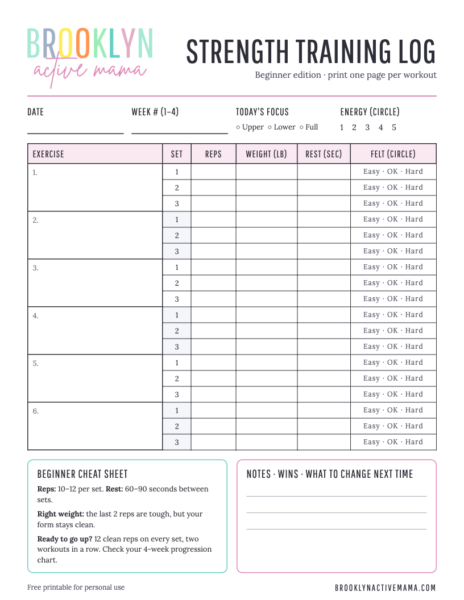
Download your free strength training log here.
Sets, Reps and When to Increase the Weight
Understanding gym terminology keeps you from feeling lost when looking at your tracking sheet:
- Rep (Repetition): Performing an exercise one time (e.g., squatting down and standing back up once).
- Set: A group of consecutive reps performed together without stopping (e.g., doing 10 squats in a row is 1 set).
- Rest Interval: Taking 60 to 90 seconds of rest between sets to allow your muscles to recover short-term energy stores before lifting again.
For beginner routines, aim for 3 sets of 8 to 12 repetitions for each exercise.
When Should You Move Up in Weight?
Use your printable to monitor your effort. If you can complete all 3 sets of 12 reps with smooth, controlled form and feel like you could have done 2 more reps without your mechanics breaking down, it is time to progress! Increase the dumbbell weight by the smallest possible increment (usually 2.5 to 5 lbs). The first week with the heavier weight might bring your completed reps down to 8 or 9, which is completely normal. Work your way back up to 12 reps before bumping the weight again.
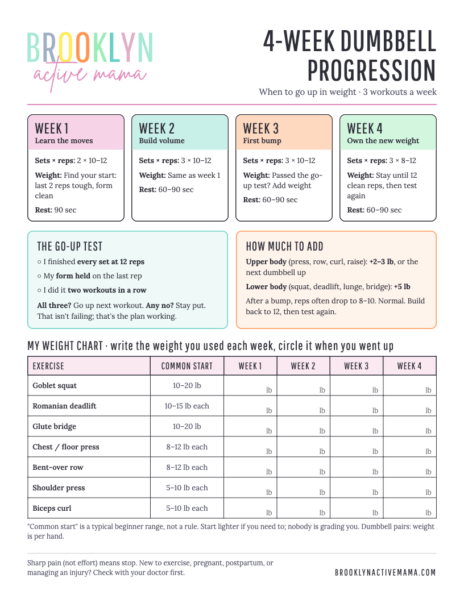
Download your free 4 week dumbbell progression here.
Rest Days and Recovery
Strength training creates microscopic tears in muscle tissue; the actual muscle rebuilding and strength gains happen when you are resting outside the gym.
Treat your rest days with the exact same respect as your lifting days. Ensure you space heavy lifting sessions with at least one day of recovery in between so your central nervous system and muscles fully reset. Pay close attention to what your body tells you: standard muscle soreness is normal, but sharp pain or persistent joint fatigue is a clear signal that you need an extra day of light walking and gentle mobility work.
Real-Time Record-Keeping
One of the greatest benefits of using a physical printable is that it forces real-time record-keeping. When you finish a set of chest presses, you write down the exact weight and rep count immediately, while your pencil is in your hand and the effort is fresh.
Relying on memory to log exercises hours later on your phone often leads to inaccurate estimates. Keeping your tracker flat on the floor beside your weights keeps you grounded in the workout you are actively doing.
See below for some amazing printables that you will find incredibly useful on your strength training journey, happy lifting!
Must Have Strength Training Printables
Here are some fantastic strength training workout printables that you can add to your workout journal or bring to the gym with you!

30 Day Workout Plan for Beginners (+ Easy Free Printable)
You get a free illustrated printable along with this 30 day workout plan for beginners!
Also, all the workouts are designed specifically for a busy schedule.

How to Build a Strength Training Routine (Free Worksheet!)
If you’re still getting the hang of strength training, here are key moves to include to build a strength training routine.

Free Printable 30 Day Exercise Challenge: Easy, Medium, & Hard Levels!
No equipment needed

Free Fitness Charts: Printable Exercise Routines & Workouts to Help Reach Your Fitness Goals

6-Week Workout Plan for Strength and Cardio
This workout routine for women at home combines cardio and strength training to completely level up your physical fitness in just six weeks.

Printable 30 Day Burpee Challenge for Beginners
This 30 Day Burpee Challenge will test not only your physical fitness, but your mental strength as well. Completing these types of HIIT exercise on a daily basis is a great way to see your strength and cardiovascular fitness improve.

Yoga Ball Full Body Challenge — cardio coffee and kale
Yoga balls; also known as exercise balls, stability balls, Swiss balls, physiology balls, are large vinyl balls you can use to stretch and strenghen your body while also improving your core strength and balance.

Thursday - Upper Body Strength Training · WorkoutLabs Fit
Each workout includes sets, reps and rest times.

30 Day Strength Training Challenge for Runners
Working your way through a strength training program for runners helps prioritize those strength exercises without requiring you to completely overhaul your training plan.
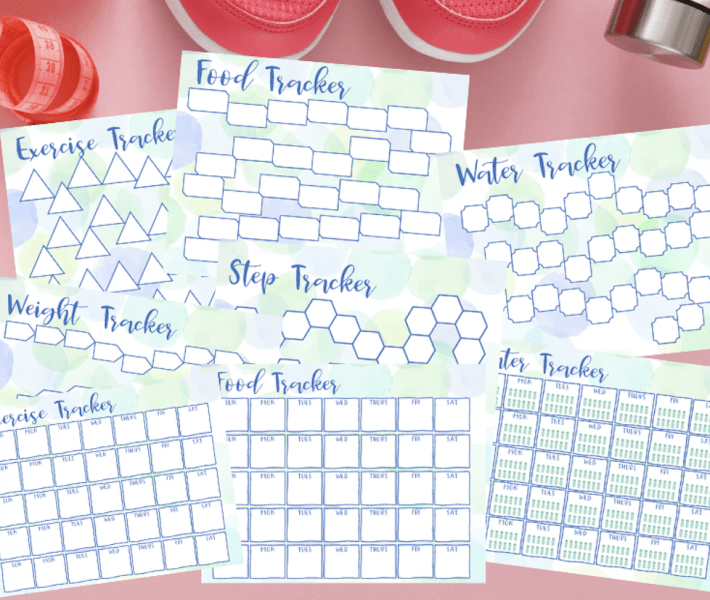
Before you go don’t forget to grab your free Fitness Journal Health Goals Tracker here!

Hi! I’m Nellie. I am an entrepreneur, a busy mama of 3 and a wife to my high school sweetheart. I have been sharing content for over 12 years about how to cook easy recipes, workout tips and free printables that make life a little bit easier. I have been featured in places like Yahoo, Buzzfeed, What To Expect, Mediavine, Niche Pursuits, HuffPost, BabyCenter, Mom 2.0, Mommy Nearest, Parade, Care.com, and more!
Get comfortable and be sure to come hang out with me on social. Don’t forget to grab your free fitness journal before you go!

I can’t see the printable. There are so many ads it’s hard to find the printable.
the printables are all inside of the links provided